We Did It Clip Art Dr Seuss Hats Off to Us
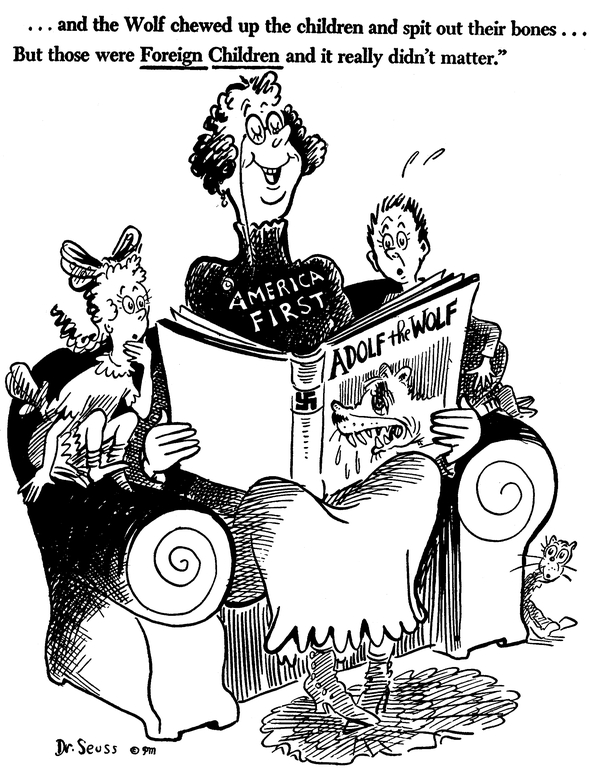
Published on October 1, 1941; Special Collection & Archives, UC San Diego Library
Past Natasha Karunaratne
Many of us know Dr. Seuss for his iconic children's books, from The Cat in the Hat to Light-green Eggs and Ham , just in his heyday of the Earth State of war Ii era author and illustrator Theodor Seuss Geisel was known for his political cartoons, like this one of "foreign children" being eaten in a children'due south volume that is being read past a woman wearing an America First turtleneck . In such cartoons as this one, Dr. Seuss critiqued American isolationism during WWII and the state's initial failure to see the humanity in the "foreign children" beingness killed by "Adolf the wolf." Dr. Seuss took on many political and social topics, from anti-isolationism in Horton Hears a Who to racial equality in The Sneetches , anti-absolutism in Yertle the Turtle , anti-materialism in How the Grinch Stole Christmas , and environmentalism in The Lorax ( Forest ). However, his views greatly varied over his career, specially regarding his attitude towards the Japanese. Dr. Seuss was not alone in his xenophobic perceptions of the Japanese, simply rather aligned with greater American club, making his political cartoons a perfect way to sympathise Americans' views of the 'other' during Globe War II.
Dr. Seuss began his career by supporting the American cause and advertising for the ownership of war bonds. Even so, this pro-war view went manus-in-hand with a racist delineation of the Japanese, as Hideki Tojo was depicted every bit the enemy in a peculiarly racialized way.
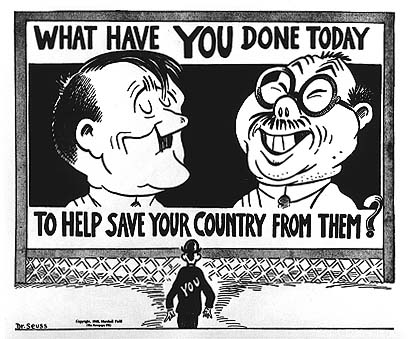
Published on March v, 1942; Special Drove & Athenaeum, UC San Diego Library

Published on October thirteen, 1942; Special Collection & Athenaeum, UC San Diego Library
This depiction presently escalated to illustrating the Japanese with extremely xenophobic tropes, such as with the notion that their numbers were growing into an invasion, or that Japanese-Americans were in cahoots with Japanese bombers in the homeland.

Published on December 10, 1941; Special Collection & Archives, UC San Diego Library
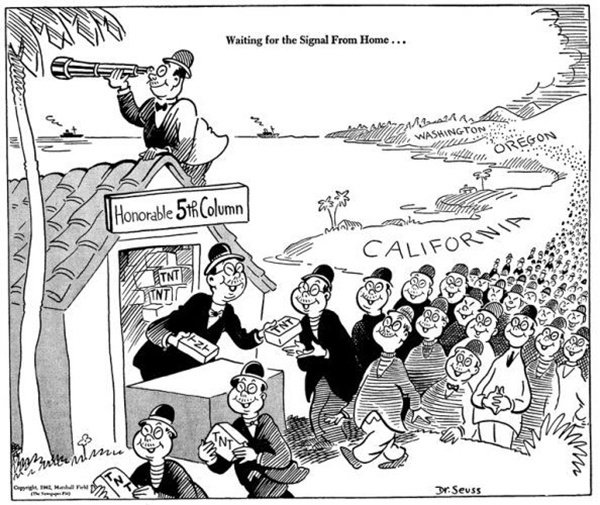
Published on February xiii, 1942; Special Drove & Archives, UC San Diego Library
While Dr. Seuss' accept on the Japanese was in line with the greater American perception, eventually leading to the internment of Japanese-Americans, these racialized views did stand in contradiction to Dr. Seuss' stance on Germany's persecution of the Jews. His images were critical of the isolationist stance of many Americans, fifty-fifty suggesting that the country take in more refugees from Nazi terror.
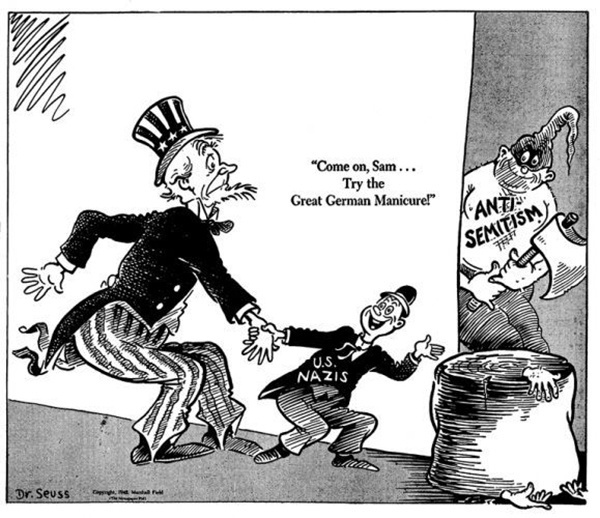
Published on Apr 1, 1942; Special Collection & Athenaeum, UC San Diego Library
Alongside his troubling images of the Japanese, were his depictions of Blacks as "savages, living in the tropics, dressed in grass skirts" and Arabs every bit "camel-riding nomads or sultans" ( Edwards ).

Published roughly between 1930 and 1940; Special Collection & Athenaeum, UC San Diego Library
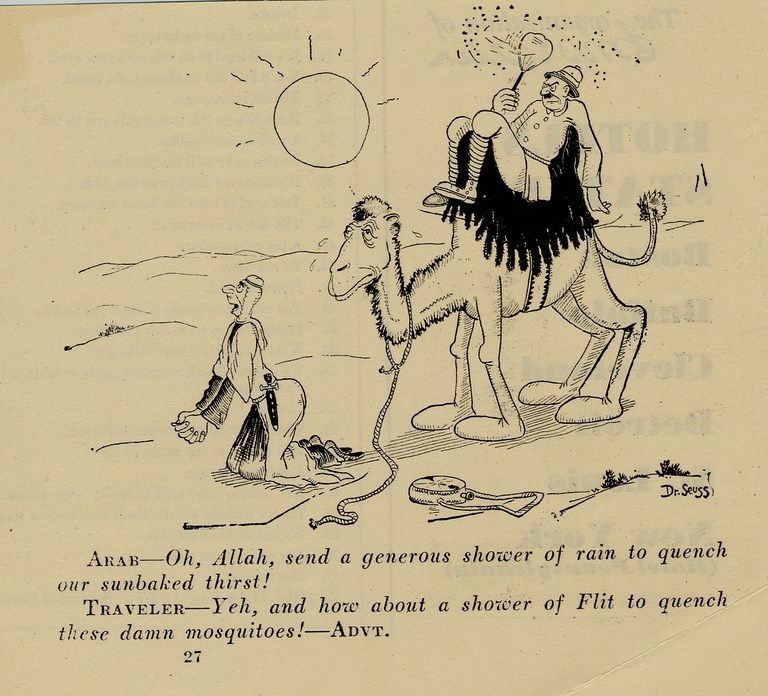
Published roughly betwixt 1930 and 1940; Special Collection & Archives, UC San Diego Library
Dr. Seuss eventually re-evaluated his xenophobic thinking towards the Japanese. In 1953 he visited Nihon and witnessed the atrocious backwash of the Hiroshima bomb, catalyzing his alter in centre. In 1954 he published Hortons Hears a Who! as an allegory for America's postwar occupation of Japan, dedicating the book to 'My Great Friend, Mitsugi Nakamura of Kyoto, Japan." As Dr. Seuss began retracting his anti-Japanese views, he went nigh illustrating more prosocial campaigns, such as that of anti-isolationism, anti-materialism, and environmentalism. While many laud his 1953 children'southward book, The Sneetches , for the ways it tackles racism, some critics notation that Dr. Seuss never did change his physical depiction of Japanese or Black people – rather just the ways in which he explored the miracle of racism.
What exercise you think?

Published on June 11, 1942; Special Collection & Archives, UC San Diego Library
To view more of Dr. Seuss' political cartoons visit University of California San Diego'due south Special Collection " Dr. Seuss Went to State of war ."
Reflection Questions:
- Pick 1 cartoon from this commodity. Who is represented in this image? What does their visual and textual context tell us about what Dr. Seuss might accept hoped to convey near this person or these people? When was this cartoon published? Does this depiction mirror or contradict the greater American perception of this person or these people at the time of its publishing?
- Dr. Seuss illustrated Japanese-Americans using many stereotypical tropes often placed upon immigrant communities. What are these tropes and how are they used today to antagonize immigrants?
- The treatment and understanding of Japanese-Americans within America was highly dependent on American relations with the country of Nihon. Is it always the case that American club views an immigrant community based on politics with that nation? If and then, when else and if non, when was this dissimilar?
- How practice we make sense of the ways people's attitudes towards immigrants evolve?
- Look upwards political cartoons related to American immigration today. What do nosotros learn from these?
This is office of our Media Highlight Serial which aims to support curriculum virtually migration through the exploration of storytelling – this includes literature, moving picture and more.
bermudezthairstur.blogspot.com
Source: https://reimaginingmigration.org/dr-seuss-political-cartoons/
0 Response to "We Did It Clip Art Dr Seuss Hats Off to Us"
Post a Comment